You know the patient you want to reach. “Everyone over 50 who hasn’t had an oral cancer screening in a year.” “Everyone who accepted a treatment plan in the last 90 days but never scheduled — and doesn’t have a big outstanding balance.” You can describe that patient in a sentence. The question is whether your software can act on the sentence, or whether you’re stuck picking an appointment type from a dropdown and pulling an “overdue” list. Real dental patient segmentation is the ability to reach the exact situation you have in mind — and it’s the quiet reason some recalls convert while blast lists don’t.
In most of the category, “targeting” means one of two things: filter by appointment type, or export an overdue list to a spreadsheet. Both are blunt. Neither lets you combine the clinical, the financial, and the behavioral the way you actually think about your patients. So you send a broader message to a broader list and accept a worse response, because the tool can’t express the audience you had in mind.
Describe it in plain English; ELVA builds the segment
ELVA’s audience builder inverts that. You describe the audience in plain language and ELVA assembles it — no SQL, no spreadsheets, no exporting lists to a third-party tool. “Patients over 50 with no oral cancer screening in the past year.” “Accepted a treatment plan in the last 90 days, never scheduled, no balance over 60 days.” You write the sentence; the segment appears.
Under that simplicity is database-grade, composable targeting — the kind of precision that usually requires a query language, reachable from a sentence. You can stack conditions with AND and AND-NOT (exclude) logic across:
- Clinical conditions and medical alerts — flags from the practice’s own records (for example diabetes, pregnancy, or blood-thinner alerts).
- Procedure history — patients who had, or never had, a given procedure, with or without a time window.
- Appointment recency, both directions — last visit of a type N+ units ago, within the past N, or no visit of that type at all.
- Financial targeting — balance over a dollar amount, or balances aged N+ days.
- Treatment-plan status — accepted a plan within a window.
- Schedule events — cancelled without rescheduling, or no-showed within a window.
- Demographics and tenure — age over, under, or between; patients first seen within a time window.
Why the combination is the point
Any tool can filter by one thing. The sophistication — and the conversion — lives in the combination. “Over 50, overdue for a screening” is a clinical filter. “Accepted a plan, never scheduled, no large balance” is clinical plus financial plus behavioral, stacked with an exclusion. That second audience is a real, specific revenue opportunity hiding in your database, and a tool that can only filter by appointment type can’t see it. ELVA targets the exact patient situation, not the nearest available category — which is precisely why a recall to that audience converts where a blast to “overdue patients” doesn’t: the right message reaches the right patient at the right moment, because the audience was the right one to begin with.
It’s worth being clear about the altitude here: you describe the outcome you want, and ELVA assembles the segment. The point isn’t the query mechanics — it’s that the precision of a database is reachable in the language you already think in.
Targeting is half; the other half is what happens next
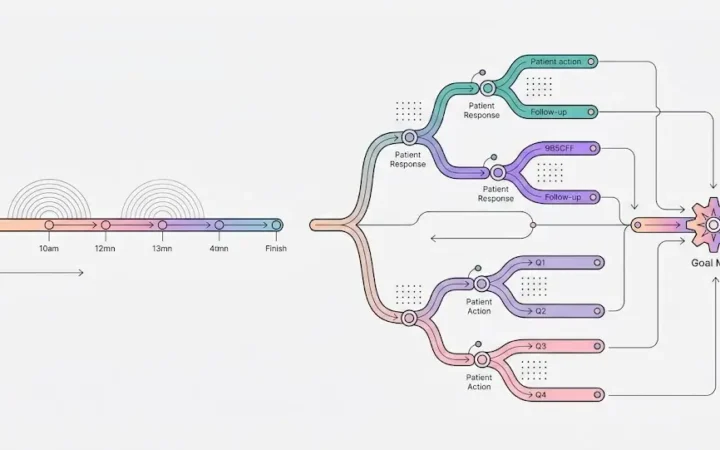
A precise audience is only valuable if what reaches it is equally considered. Once ELVA has assembled the segment, the sequence builder works it across channels and adapts to each patient’s response, and every message is composed individually by the ELVA Brain — so a tightly-defined audience receives tightly-relevant messages, not a generic blast that happens to go to a better list. The reason ELVA can target on the practice’s real clinical and behavioral data at all is the same reason it can do everything else: it’s built on an intelligence that has learned how the practice’s data actually fits together.
See the audience builder in the wider engine on the ELVA Recall page, or start from reminders vs. a recall engine.
Frequently Asked Questions
What is dental patient segmentation?
It’s defining a precise group of patients to reach based on their actual situation — clinical conditions, procedure history, appointment recency, financial status, treatment-plan status, schedule events, and demographics — rather than a single blunt filter like appointment type or an “overdue” list. Precise segmentation is why a targeted recall converts where a broad blast doesn’t.
How does ELVA’s plain-language audience builder work?
You describe the audience you want in plain English and ELVA assembles the segment — no SQL, spreadsheets, or list exports. Underneath is composable targeting that stacks clinical, financial, behavioral, and time-based conditions with include and exclude logic, but you reach it by writing a sentence.
Can I combine clinical and financial filters in one audience?
Yes — the combination is the point. You can stack conditions like “accepted a treatment plan in the last 90 days, never scheduled, with no balance over 60 days,” mixing clinical, financial, and behavioral criteria with AND and AND-NOT logic to reach a specific situation rather than a broad category.
Why does precise targeting matter for recall results?
Because the right message only works if it reaches the right patient at the right moment. A blast to “overdue patients” gets a blast’s response rate; a recall to a precisely-defined audience reaches people for whom the message is genuinely relevant, which is why precise segments convert where broad lists don’t.
Do I need technical skills to build an audience?
No. The database-grade precision is reachable from a plain-English description — you describe the outcome you want and ELVA builds the segment, so you get query-level targeting without writing a query.
Reach the exact patient you’re picturing. See ELVA Recall, or what happens once the audience is built in adaptive sequences.