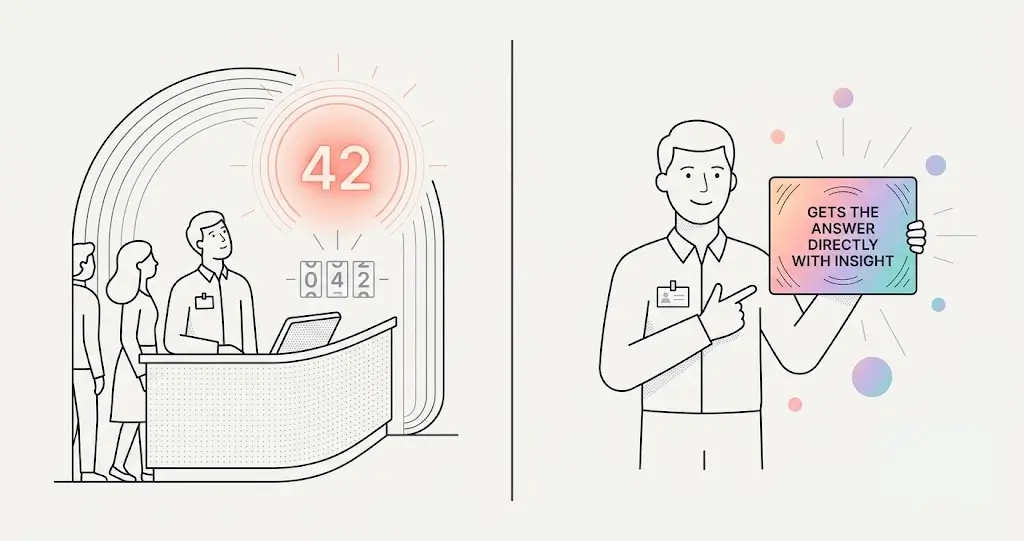
Here’s a moment most practice owners will recognize, even if they’ve never said it out loud: standing behind their own front desk, waiting for a team member to finish with a patient, just to ask what the practice produced yesterday. You own the business. You carry it in your head at all hours. And yet the simplest questions about it — what did we do yesterday, how’s the month shaping up, is tomorrow full — somehow aren’t yours to answer directly. If you can’t see your own dental practice data without asking someone, the problem isn’t you, and it isn’t your team. It’s that the tools were never built for the owner.
It’s a strange kind of dependence. You’re the owner, and you’re standing in line for your own numbers. The questions belong to whoever happens to be free at the front desk and knows their way around the software.
How we got here
It isn’t anyone’s fault, and it isn’t the software’s fault either. Your practice management system is genuinely good. It’s the system of record, it runs the whole place, and it’s earned its keep. But here’s the thing nobody says: your PMS was built for your front desk, not for you. It was designed for the person who lives in it all day — who knows which screen, which filter, which report, which checkbox. It rewards expertise and daily repetition. That’s exactly right for the role it was built for. It’s just not built for the owner who wants to glance at his business between patients, or at the end of a long day, and simply know how things are going.
So you do one of two things. You sit down and try to learn a system that fights you every step — and you give up, because you have patients to see and you didn’t go to dental school to master report filters. Or you ask. You wait for someone who knows the software to pull it for you. And every time you ask, you’re pulling your most capable person off a patient to look something up — for the person who signs their paycheck.
The real cost isn’t the time
Losing a few minutes here and there isn’t the problem. The problem is quieter than that. When you can’t see your own business without help, you start to feel one step removed from it. You know what’s happening through other people. Decisions wait until you can ask. The pulse of your practice — the thing you’re ultimately responsible for — reaches you secondhand, filtered through whoever had a moment to check.
For something you own, that’s a small daily indignity. You should be able to see your own practice the way you see your own bank account: whenever you want, without asking anyone’s permission, in language you understand.
What owners actually want isn’t another dashboard
The answer most owners are offered is a dashboard — forty widgets to configure, another system to learn. But that’s just the same problem in a new outfit. What an owner actually wants is almost embarrassingly simple: to ask.
“How much did I make yesterday?” “What does my day look like?” “Are we ahead of last month?” — and just get the answer. No screens, no filters, no waiting. The way you’d ask a sharp office manager who happened to know everything and never minded the interruption. That’s what ELVA Chat is built to be. It connects to the practice management system you already have — the one that already runs your practice — and lets you simply ask it anything about your business, in plain English. You type a question the way you’d say it out loud, and the answer comes back from your own data. No training. No expertise required. The interface is a sentence.
This isn’t about replacing your front desk
That’s the first thing people assume, so it’s worth being clear. Your team is not the problem, and ELVA Chat isn’t here to replace them. A great front desk is one of the most valuable things a practice has. The point isn’t to need them less — it’s to stop needing to borrow their time and their expertise just to understand your own practice. Let them do what they’re great at: taking care of patients. And let yourself finally have direct, unfiltered, on-demand access to the business you built — without standing in line for it.
The bottom line
You own the practice. Seeing it clearly shouldn’t be the hard part. For most owners it has been — not because they’re not capable, but because the tools were built for the front desk and the owner was left to ask. It doesn’t have to be that way. You should be able to look at your own practice anytime you want, just by asking. That’s the whole idea behind ELVA, and it’s the start of a set of everyday frictions worth removing — like the fact that your best thinking about the practice tends to happen at 9pm, long after the front desk has gone home.
Frequently Asked Questions
Why is it so hard for a dentist to see their own practice data?
Because the practice management system was built for the front desk, not the owner — it rewards daily expertise with screens, filters, and reports. An owner who wants a quick answer either has to master a complex system or ask a staff member to pull it, which means borrowing their most capable person’s time to understand his own business.
How can I check my practice numbers without learning the PMS?
By asking in plain English. ELVA Chat connects to your existing practice management system and lets you type a question the way you’d say it — “how much did I produce yesterday?” — and get the answer from your own data, with no screens, filters, or training required.
Does this replace my front desk?
No. ELVA Chat isn’t a replacement for your team — a great front desk is one of a practice’s most valuable assets. The point is to stop needing to borrow their time and expertise just to understand your own practice, so they can focus on patients while you get direct access to your numbers.
Do I need a new dashboard or system to learn?
No. The whole idea is to avoid another system with widgets to configure. The interface is a sentence — you ask a question and get an answer from your real data, rather than navigating a new tool.
Where does ELVA Chat get its answers?
From your own practice management system. It connects to the system that already runs your practice and retrieves the real figures, then phrases them in plain language — so the answer reflects your actual data.
See your practice by asking. Learn how ELVA connects to the system you already run, or read the next piece on why your practice questions show up at 9pm.