Every growing dental group eventually runs the same experiment. Call volume rises, the schedule gets harder to manage, collections slip, and the obvious answer presents itself: hire more front-desk staff. So you do. And for a while it helps. Then you acquire two more locations, volume rises again, and you’re back where you started — except now your largest and least predictable operating expense is a front-desk payroll that grows in lockstep with your footprint. If you’re trying to work out how to scale a dental front desk, that experiment is the trap.
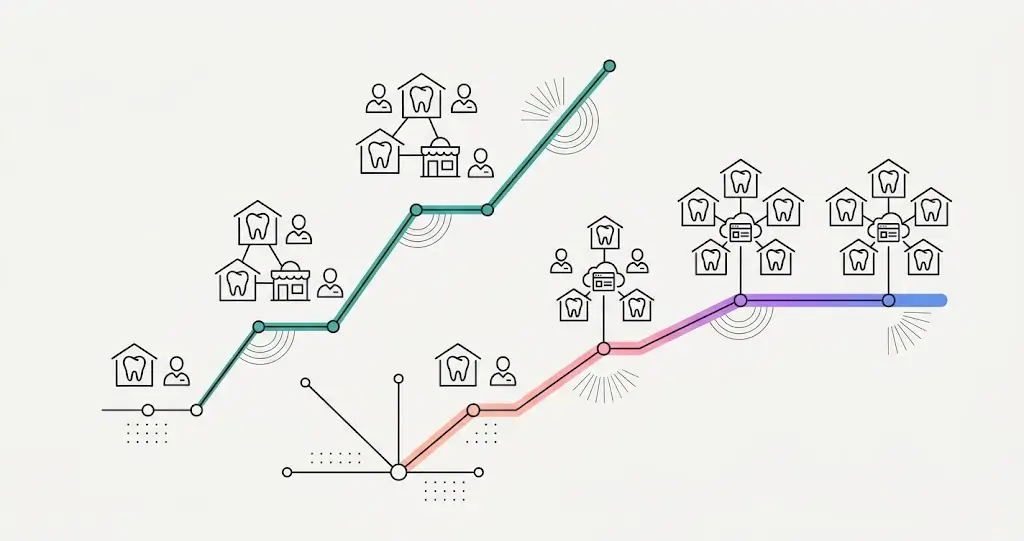
The uncomfortable truth is that the front desk, as traditionally staffed, won’t scale. Not because the people aren’t good, but because the model is linear: more patients require more bodies, and more bodies require more hiring, more training, more turnover backfill, and more variance. You’re not building leverage. You’re buying the same constraint again at each new location.
Why headcount is a linear answer to a compounding problem
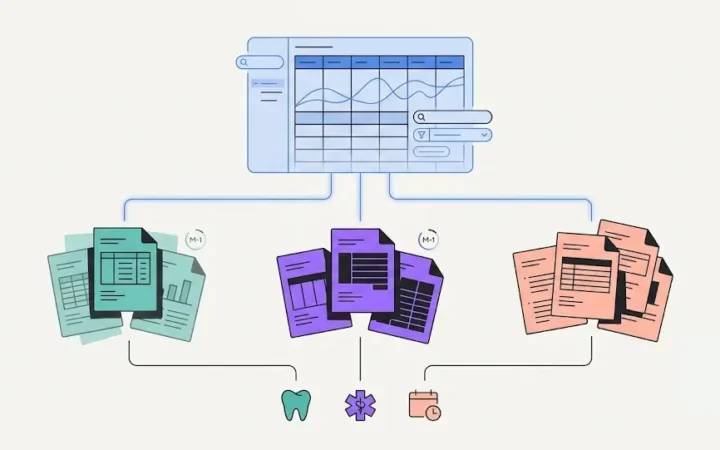
Front-desk work is a bundle of high-volume, repeatable tasks: answering calls, booking appointments, verifying insurance, reminding patients, collecting balances, filling cancellations. When you solve that bundle with people, three costs scale with you:
- The hiring treadmill. Front-desk roles have high turnover. A group that needs more front-desk capacity is also, permanently, a group that’s recruiting, onboarding, and backfilling those roles. The cost isn’t just salary; it’s the perpetual machinery of replacement.
- The knowledge that walks out the door. Your best front-desk person carries the payers, the scripts, the scheduling logic, and the patient quirks in their head. When they leave, that institutional knowledge leaves too, and the new hire rebuilds it slowly — at the cost of the exact things (collections, denial prevention) that depend on knowing the details.
- The variance. Two locations with two front desks deliver two different patient experiences, two different collection rates, two different denial rates — because outcomes depend on who happens to be working. Variance is the enemy of a standardized brand, and it grows with location count.
Add headcount and you address the volume for a quarter. The treadmill, the knowledge drain, and the variance all remain — and all scale.
How to scale a dental front desk: make the work itself scale
The way out isn’t a bigger front desk. It’s removing the linear dependency between patient volume and human headcount for the tasks that don’t actually require a human. The repeatable bundle — calls answered, appointments booked, insurance verified, reminders sent, balances collected, cancellations filled — is precisely the work an AI receptionist can handle without turning over, forgetting the payers, or performing differently at location one and location forty.
When the routine volume is absorbed by infrastructure rather than headcount, three things change. Capacity stops being a hiring problem. Institutional knowledge lives in the system instead of in a person who might quit. And every location performs to the same standard, because the standard is encoded once rather than re-taught with each new hire — which is the whole point of standardizing across a DSO or group practice.
This doesn’t eliminate the human front desk. It changes its job. Freed from the repeatable bundle, your front-desk people do the things that genuinely need a human — the complex conversation, the upset patient, the judgment call — instead of drowning in the volume that doesn’t. You’re not replacing the team. You’re removing the work that was making the team a scaling bottleneck. (And the people who manage across locations can keep an eye on every office from the mobile app, rather than being physically tied to one front desk.)
What this looks like in EBITDA terms
For an operator or a sponsor, this is the difference between two growth models. In the headcount model, front-desk cost is a roughly fixed percentage of revenue that travels with you to every new location — you never escape it, you just keep paying it. In the infrastructure model, the routine front-desk capacity is largely decoupled from headcount, so as you add locations, you’re not adding the same proportional administrative load each time.
That decoupling is exactly the kind of operating leverage that shows up in margin and that a diligence room rewards. A group that can add a location without adding a proportional slug of front-desk payroll has a structurally better unit-economic story than a group that scales people in lockstep with patients. The first group built leverage. The second built a bigger version of the same constraint.
The question to ask before the next hire
The next time the front desk is underwater and the reflex is to post a job, ask a different question first: which of these tasks actually requires a person, and which are we staffing only because we’ve always staffed them? The volume that’s drowning your team is mostly the second kind. Hiring against it works until the next growth spurt. Removing it from the human workload is the only answer that scales — because it’s the only one that doesn’t have to be bought again at every location you open.
Frequently Asked Questions
How do you scale a dental front desk without adding staff?
By removing the linear dependency between patient volume and headcount for repeatable tasks — calls, booking, insurance verification, reminders, collections, cancellation fills — and handling them with infrastructure that doesn’t turn over and performs identically across locations, while staff focus on work that genuinely needs a human.
Why can’t a dental front desk scale by hiring more people?
Because the model is linear: more patients require more people, and more people bring a permanent hiring treadmill, institutional knowledge that leaves with turnover, and growing variance between locations. Headcount addresses volume temporarily, but the underlying costs scale with your footprint.
Does automating front-desk work mean replacing the team?
No. It changes the team’s job. Freed from high-volume repetitive tasks, front-desk staff handle complex conversations, upset patients, and judgment calls — the work that actually requires a person — instead of being a scaling bottleneck.
How does this affect a dental group’s margins?
It introduces operating leverage. In a headcount model, front-desk cost travels to every new location as a roughly fixed percentage of revenue. Decoupling routine capacity from headcount means adding locations without adding the same proportional administrative load — a stronger unit-economic story.
Which front-desk tasks still need a human?
Complex or sensitive conversations, escalations, upset patients, and genuine judgment calls. The repeatable, high-volume bundle (answering, booking, verifying, reminding, collecting, filling gaps) is what can be absorbed by infrastructure so people can focus on the rest.
See what scaling without headcount looks like. Explore how multi-location groups standardize front-desk operations with ELVA for DSOs.