A single-practice owner can walk the floor and feel how the day is going. A DSO operator running twenty or fifty locations has no such instrument. The information arrives the way it always has — in roll-up reports, assembled by hand, delivered well after the period they describe. By the time you see that a location is behind on production, that AR is piling up at three offices, or that tomorrow’s schedule is full of unconfirmed appointments, the moment to act has usually passed. Getting real-time visibility across a multi-location dental group is less about better reports and more about removing the two things that make the reports late in the first place.
Those two things compound each other. The first is latency. The questions you most need answered are about right now — which locations are trending down this week, where collections are slipping, which offices are under-booked tomorrow. But the reporting cadence is monthly, because assembling the picture is manual work. You’re flying a multi-location business on instruments that refresh once a month.
The second, which makes the first far worse, is heterogeneity. DSOs grow by acquisition, and acquired practices arrive on whatever PMS they were already running — one on Open Dental, another on Dentrix Ascend, one you bought last year on Dentrix Classic. The picture you’re assembling has to be pulled from several systems that don’t speak to each other, each with its own reports and its own definitions. That’s exactly why the cadence is monthly — and why the unified view, when it finally arrives, is so often an approximation.
Both standard responses make things worse. Forcing every location onto one PMS means migrations — expensive, disruptive, risky, often met with staff revolt. Leaving every location on its own system means a permanent patchwork of incomparable reports. Neither gives you what you actually need: one current view of the whole group.
A unifying layer over the systems you already run
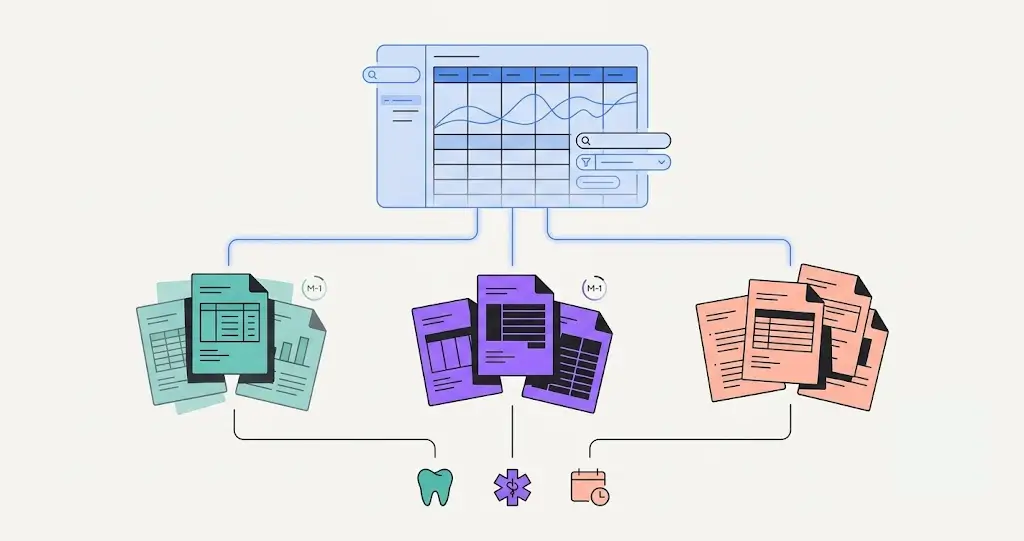
This is where ELVA’s design pays off for a multi-location group, and the relevant architecture is the part most people overlook: the Brain isn’t a PMS, and it doesn’t ask you to replace yours. It’s an intelligent layer that sits on top of whatever each location runs. The differences between Open Dental, Ascend, and Classic are absorbed at the integration layer, where ELVA connects to each. Above that layer — where you actually work — the experience is uniform. The previous piece covered what this means for operating a mixed-PMS group; this is the other half — what it means for seeing one. One Brain across the whole group means one place to look, regardless of what each location runs underneath.
Under the hood — Total Context across locations. The Brain operates on a single shared context (one of the four architectural layers in the architecture piece). Because every location’s live data flows into that one context — and because the Brain holds a confirmed, consistent definition of what each metric means (see how ELVA learns your practice) — a question asked across locations returns a coherent answer rather than a reconciliation of mismatched reports. The integration layer normalizes the differences between PMS systems so the intelligence layer doesn’t have to.
The latency problem dissolves in the same motion. When the group’s information lives in one queryable Brain rather than scattered across systems waiting to be assembled, you don’t wait for month-end. You ask — across all locations, one, or a region — and the answer is current. The picture stops being a monthly artifact you receive and becomes something you can interrogate the moment a question occurs to you.
What this gives a DSO operator
It makes the portfolio glanceable in a way it never has been. The questions that used to require a request, a wait, and a hand-assembled report — which locations are behind this week, where AR is concentrated, which offices are under-booked tomorrow — become things you ask and immediately see, across a mixed-PMS group, without anyone assembling anything.
It lets you act while it still matters. A problem you can see today is a problem you can fix today. Month-old visibility is, by definition, visibility of problems you can no longer prevent — only account for. Current visibility turns the same information from a record into a lever.
And it does all of this without a migration. You keep the proven systems each location depends on; the unification happens above them, not by replacing them.
Where the series goes next
There’s one more dimension a DSO has to confront. It doesn’t just have to run its practices well and see them clearly — it has to be able to defend how it operates, and how it uses AI, to stakeholders a single practice never answers to: a board, investors, a compliance function. An autonomous system touching patient data and making decisions is precisely what those stakeholders scrutinize. That’s the next problem.
This is problem five of seven structural problems every multi-location group hits.
Frequently Asked Questions
How can a DSO get real-time visibility across locations on different PMS systems?
With an intelligence layer that sits on top of each PMS rather than replacing it. ELVA’s integration layer normalizes the differences between Open Dental, Dentrix Ascend, and Dentrix Classic into one shared context, so a question asked across locations returns a current, coherent answer instead of a hand-assembled reconciliation of mismatched reports.
Why is DSO reporting usually monthly and late?
Because assembling the picture is manual work, made worse by heterogeneity — data pulled from several PMS systems that don’t speak to each other, each with its own reports and definitions. The manual unification is why the cadence is monthly and why the unified view is often an approximation.
Do I have to migrate everyone onto one PMS to see the whole group?
No. Forcing one PMS means costly, disruptive migrations; leaving everyone separate means incomparable reports. ELVA unifies above the PMS layer — you keep each location’s system and get one current view of the group without a migration.
What makes cross-location numbers actually comparable?
A confirmed, consistent definition of what each metric means, held in the Brain. Because every location’s data flows into one shared context with one definition of “production” or “AR,” a cross-location question returns a coherent answer rather than a reconciliation of differently-defined reports.
Why does real-time visibility matter more than month-end reporting?
Because a problem you can see today is one you can fix today. Month-old visibility only lets you account for problems you can no longer prevent. Current visibility turns the same information from a record into a lever you can act on while it still matters.
See your whole group in real time. Explore how the shared-context layer works in the architecture of the Practice Brain, or see ELVA for multi-location groups.